Commercial demolition, London and Kent
Demolition contractors. Method statement written before we start.
- Registered since 2010
- Upper tier waste carrier
- Rated 4.8 on Google
-
Registered since 2010
-
Upper tier waste carrier
-
Rated 4.8 on Google
-
Based in Gravesend, Kent
Working across London and the South East
What a commercial demolition job includes
- Top-down demolition with 360 excavators
- Hydraulic breaker, shear and grab attachments
- Water to keep the dust down
- Method statement written before work starts
- Waste separated into skips and roll-on roll-off containers
- Concrete and brick crushed on site
What happens after you call
You call or send the form
We talk through the building, the site, access and your programme.
Site visit and written quote
We walk the site, check the neighbouring buildings and services, and quote in writing.
Surveys and notices
An asbestos survey comes first. The Section 80 notice goes to the council, which has up to 6 weeks to reply. Gas and electricity are cut off before work starts. The guide explains each rule: Before you demolish.
Method statement
Written before work begins, as CDM 2015 regulation 20 requires, and shared with you.
Demolition
Top-down demolition with a 360 excavator, water to keep the dust down, and a banksman on the ground.
Clearance and waste
Rubble crushed on site or taken away, the ground left level, and waste transfer notes kept for 2 years.
Watch a job from start to finish
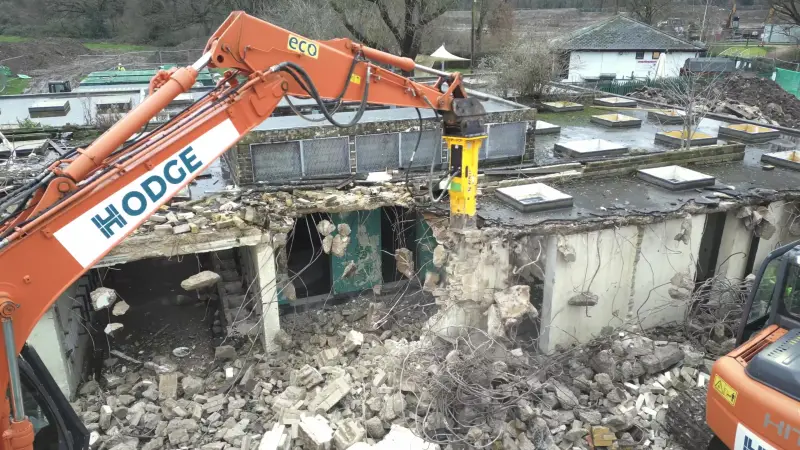
Drone footage of one of our commercial demolition jobs in London, from start to finish.
You can see the hydraulic breaker taking the building down and the rubble going through a mobile crusher on site.
Commercial demolition in London, in our project log

What clients say
BWA has had the pleasure in working with Hodge Demolition on several demolition and soft strip out projects since 2016. We were greatly impressed with their communication skills, workmanship, and commitment to maintaining a safe working environment for all.
HDL undertook the demolition and excavation of our south stand and former training pitches. All works were well planned and conducted in a safe and efficient manner.
Questions before you start
The guide explains the rules on council notices, asbestos surveys and waste.
Read the guideDo you provide a method statement?
Yes. The law requires the demolition arrangements to be written down before work begins. We write a method statement for each job, covering the order of work, the plant, dust control, exclusion zones and where the waste goes, and share it with you before we start.
Who sends the Section 80 notice?
The law puts the duty on whoever starts the demolition. The Act also requires copies to go to the occupiers of buildings next door and to the gas and electricity suppliers.
Source: Building Act 1984, section 80
Can the council limit noise and working hours?
Yes. Under Section 60 of the Control of Pollution Act 1974 a council can set working hours, noise levels and the plant allowed on site. A contractor can also apply in advance for consent under Section 61, and the council must decide within 28 days. Working to that consent is a defence against a later noise notice.
Who removes asbestos?
Higher-risk asbestos, such as sprayed coatings, pipe lagging and loose fill, must be removed by a contractor licensed by the HSE, who must notify the HSE at least 14 days before starting. Some lower-risk work, such as taking down asbestos cement sheets without breaking them, does not need a licence but still has to follow the regulations.
Source: HSE: licensed asbestos work
What records do you keep for the waste?
Every load is described on a waste transfer note, which the law requires us to keep for 2 years, and hazardous waste such as asbestos is recorded on consignment notes kept for 3 years. Our Environment Agency registration, CBDU447191, is public and you can check it on the register.
Tell us about your site
Call us or send four details. We visit the site, then quote in writing.